

You’re scrolling through comments on a video, and someone drops it: “he’s such an opp.” Or maybe your kid said it at dinner and you just nodded like you understood.That word is OPP, and it shows up everywhere from song lyrics to group chats.
OPP most commonly means opposition or opponent, someone seen as an enemy or rival, though it can also stand for a few other things depending on where you see it.By the end of this guide, you’ll understand what it means, where it originated, and how to use or respond to it with confidence.
We’ll walk through its roots in hip hop, how it shows up in texting and social media, what it means across different apps and platforms, and even the rare technical and workplace meanings people don’t expect. You’ll also see how to spot the difference between OPP and lookalike slang like OP.
What Does OPP Mean?
Slang Meaning (Most Common Use)
In everyday slang, OPP is short for opposition or opponent. It’s basically another word for enemy or rival.
You’ll see it most in hip hop and rap culture, where it started, and now it’s just as common in texting culture and on social media. Gen Z uses it constantly, often in group chats or comments, to talk about someone they’re beefing with.
Example: “He’s an opp, don’t trust him.”
It doesn’t always mean a serious enemy either. Sometimes it’s used jokingly, like calling your sibling an opp for eating your leftovers.
Other Meanings of OPP
OPP isn’t always about opposition. Its meaning can change completely depending on where you come across it.
- Other People’s Property, which is actually where the term first came from
- Other people’s problems
- Opportunity, used casually or in professional discussions
- Over Powered Player, sometimes used in gaming slang
- A vulgar acronym referencing infidelity, popularized by the Naughty by Nature song “OPP,” which stands for “other people’s” followed by a slang term for private parts
That last one is where a lot of confusion comes from. The song is decades old, but people still bring it up when they hear the abbreviation, even though the modern slang meaning has moved on from it.
Where Does OPP Come From? (Origin & Background)
The version of OPP most people use today traces back to hip hop, specifically Chicago drill music in the early 2010s. Rapper Chief Keef is widely credited as one of the first to use “opp” this way, in his 2011 track “John Madden.”
From there, the term spread fast. Other artists like Lil Reese, Travis Scott, and Playboi Carti picked it up, and by 2016 it had moved well beyond Chicago drill into mainstream hip hop.
By 2018, rappers like Cardi B and Young Thug were using it on social media, and that’s really when it crossed over into general Gen Z slang. It kept spreading through TikTok and platforms like Twitter, eventually reaching listeners far outside hip hop, including K-pop fans after BTS member Jimin referenced it in a solo track.
The term originally comes from African American Vernacular English (AAVE) and, like many AAVE expressions, became popular through music before spreading across the internet.
How Is OPP Used in Everyday Conversations
In Texting & Chat
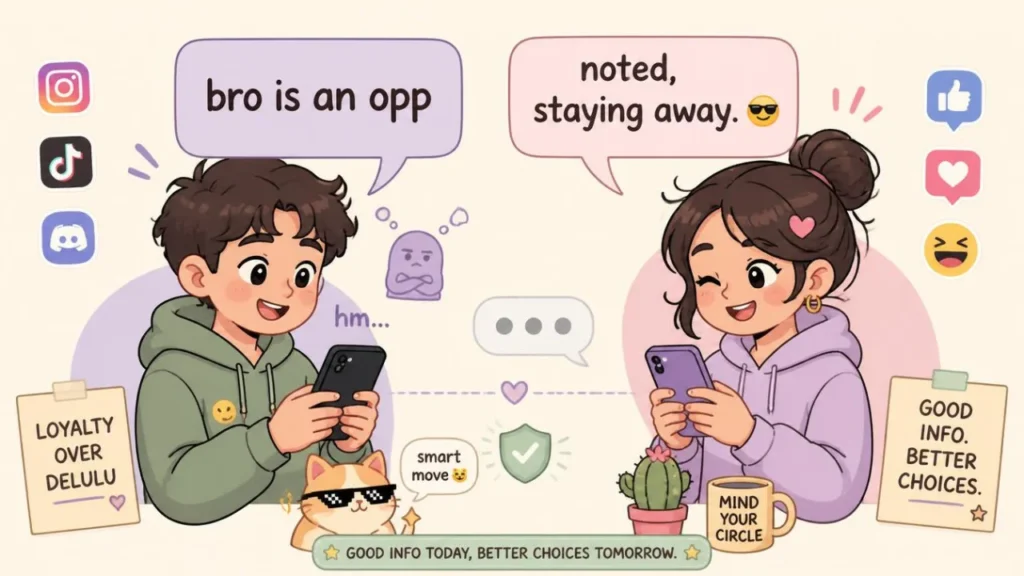
In texts and DMs, OPP usually refers to someone you don’t trust or someone you’re in a bit of conflict with. It’s casual and used without much explanation, since most people already know what it means.
[IMAGE SUGGESTION: A mock text conversation showing “be careful, she’s an opp 👀” with a friend replying “noted, staying away”]
Example exchange:
Friend: why didn’t you invite him
You: bro is an opp, no thanks
On Social Media
On platforms like Instagram, TikTok, and Twitter/X, OPP shows up a lot in captions, comments, and memes, usually tied to drama or rivalry. It’s often paired with emojis for extra effect, like 😤 or 🔥.
A lot of the time it’s not even that serious. People use it for comedic effect, like posting a photo of a messy room and captioning it “the opps did this.”
In Gaming
In gaming spaces, opp usually just means opponent, plain and simple. It’s used the same way you’d say “the other team” or “enemy player.”
Example: “Watch out, opps are camping the spawn point.”
In Songs & Music
Since the term has roots in hip hop, it still shows up constantly in song lyrics, especially in drill and trap music. In rap lyrics, artists often talk about “sliding on the opps” or “watching for opps,” using the term to refer to rivals or people they see as threats.
This is honestly where a lot of younger listeners first hear the word, long before they ever use it themselves in conversation.
OPP Meaning Across Different Platforms
The core meaning of OPP doesn’t really change much from platform to platform. What changes is how casually or seriously it’s used.
- WhatsApp: Mostly used in group chats to refer to outsiders or people the group doesn’t trust.
- Instagram: Common in captions about rivalry, loyalty, or drama, often half joking.
- TikTok: Shows up a lot in memes, POV videos, and comment sections, frequently tied back to rap lyrics.
- Snapchat: Used more privately, often to describe someone the sender personally doesn’t trust.
Across all of them, the meaning stays consistent. It’s really just the tone and context that shift.
Other Fields & Technical Meanings of OPP
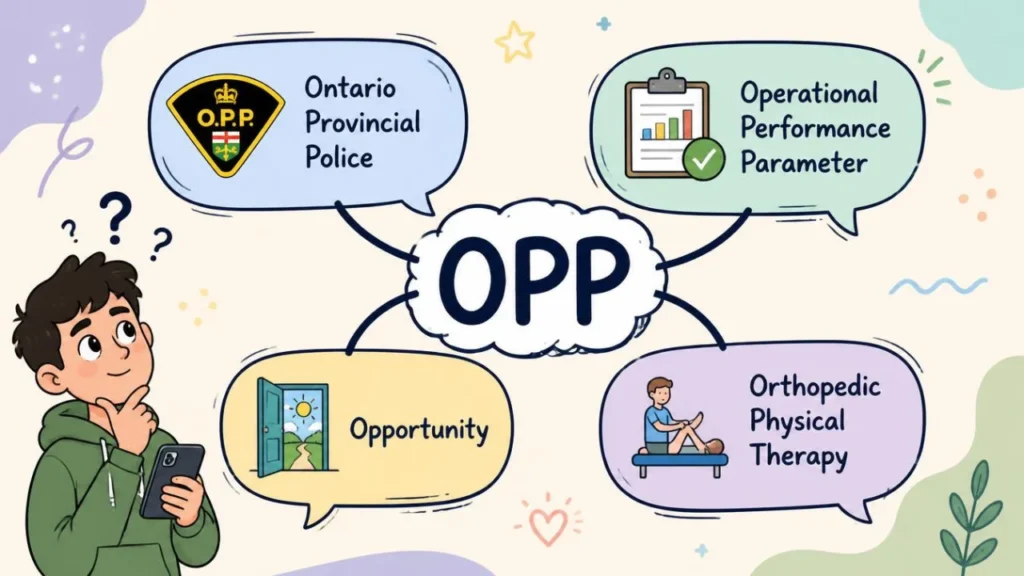
Outside of slang, OPP shows up in a few unrelated technical and professional discussions. These meanings have nothing to do with the internet slang version, so context matters a lot here.
| Field | Meaning |
| Government (Canada) | Ontario Provincial Police |
| Engineering | Operational Performance Parameter |
| Business | Shorthand for “opportunity” in internal notes |
| Medical | Occasionally used for Orthopedic Physical Therapy |
If you come across OPP in a workplace document or a technical report, it almost certainly has nothing to do with rap slang. Context is really the only way to tell them apart.
How to Respond When Someone Says OPP
If someone calls another person (or you) an opp, how you respond really depends on the tone of the conversation. Most of the time, it’s not that deep, so a light response works fine.
Friendly Chat Reply Examples
- “Why do you think he’s an opp? 😅”
- “Let’s not start drama lol“
- “No opp energy here, we good”
- “We’re just minding our business 👍”
These kinds of replies keep things neutral and stop the conversation from getting more serious than it needs to be.
OPP vs Similar Slang Terms
OPP vs OP
These two get mixed up constantly, but they mean completely different things.
- OP means overpowered, mostly used in gaming to describe something unfairly strong.
- OPP means opposition or opponent, referring to a person, not a game mechanic.
Example: “That weapon is OP” versus “he’s an opp for real.”
Other Similar Words & Alternatives
A few other words carry a similar meaning to OPP, though with slightly different tones:
- Rival, more neutral and often used in sports or business
- Enemy, more formal
- Hater, usually implies jealousy rather than direct conflict
- Foe, formal and rarely used casually
Common Mistakes & Misconceptions About OPP
A lot of people misread OPP because they only know one version of it. A few common mix ups:
- Assuming it always means something hostile or serious, when it’s often used jokingly
- Confusing it with OP (overpowered)
- Thinking it’s only a hip hop or music term, when it’s now common general slang
- Assuming it’s always offensive, when the tone usually depends entirely on context
Is OPP Offensive? Understanding Context & Tone
OPP itself isn’t automatically offensive. Like a lot of slang, it depends heavily on tone, relationship, and context.
Calling a friend an opp jokingly because they beat you in a game is very different from using it to describe someone you’re genuinely in conflict with. The word carries more weight in its original hip hop context, where it could refer to real rivalries, but in everyday texting and social media, it’s usually pretty lighthearted.
If you’re not sure how it’ll land, it’s worth reading the room first. Some people use it casually with anyone, others reserve it for people they’re actually annoyed with.
OPP in Dating Apps & Online Conversations
On dating apps and in online conversations, OPP tends to pop up when people talk about exes or people who caused drama in a past relationship. It’s also used to describe someone giving off untrustworthy vibes.
Sometimes it’s used the opposite way too, almost affectionately, like saying “no opp energy” to mean loyalty or exclusivity between two people.
Popularity & Trend History of OPP
The word has stuck around mainly because of a few overlapping influences. Hip hop and drill music kept it alive in lyrics, gaming communities adopted it for opponents, and meme culture on TikTok gave it a second life outside music entirely.
It tends to spike whenever a viral song or meme brings it back into conversation, which is honestly pretty normal for slang that started in music. It hasn’t really faded, it just shifts depending on what’s trending that month.
Real-Life Examples of OPP in Sentences
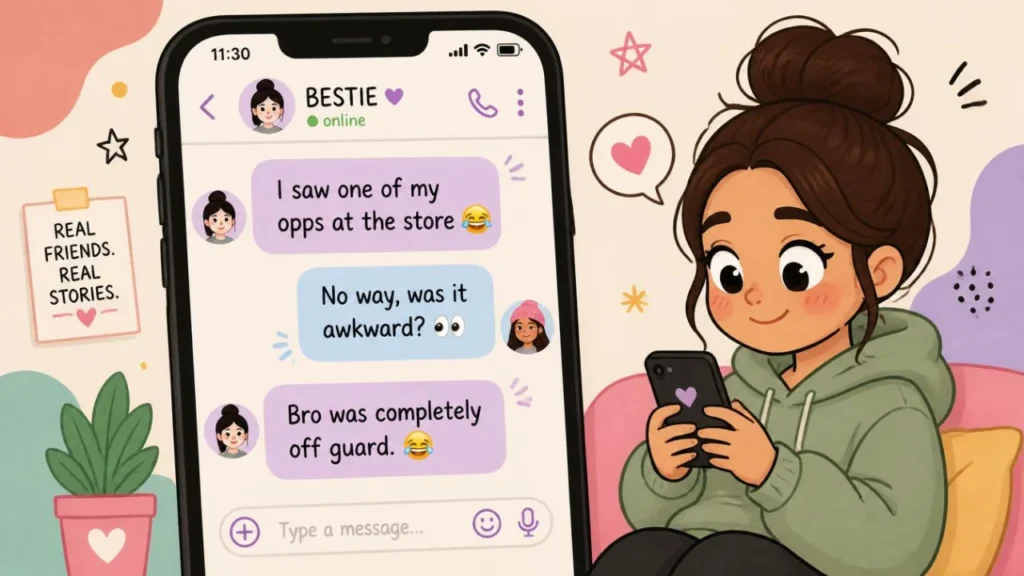
Seeing the word in real sentences makes it much easier to understand than a dictionary style definition. Here are a few natural examples:
- “I ran into one of my opps at the store completely off guard, and I couldn’t stop laughing.”
- “Prom night turned into a whole scene, opps everywhere.”
- “We clapped on the opps in that group project presentation, ngl.”
- “Why do I have 50 year old opps at work” (yes, people really do use it about coworkers)
That last example is honestly a good reminder of how far the word has traveled from its original rap roots. It’s not just teenagers using it anymore.
FAQs
How is opps used in slang?
Opps is used to describe enemies, rivals, or people you’re in conflict with. It’s often used casually or jokingly, not just in serious situations.
Is it opps or ops slang?
The correct slang spelling is “opps,” short for opposition or opponent. “Ops” without the extra P usually refers to something else, like military operations.
What does OPP mean in Gen Z slang?
For Gen Z, OPP usually just means someone they’re beefing with or don’t trust, whether that’s serious or just a joke between friends.
What is opps slang for on TikTok?
On TikTok, opps is used the same way as everywhere else, referring to rivals or enemies, often in captions, comments, or memes tied to music trends.
What does OPP mean in slang?
It usually means opposition, enemy, or rival.
Is OPP a bad word?
Not necessarily. It depends on tone and context. It can be lighthearted or genuinely negative.
What does OPP mean in texting?
It refers to someone you don’t trust or consider an opponent.
What does OPP mean in songs?
It originally referenced “other people’s property” in older music, but in modern rap and drill, it typically means opposition or rivals.
Is OPP the same as OP?
No. OP means overpowered, usually in gaming. OPP means opposition or opponent, referring to a person.
If you’ve come across other confusing internet abbreviations, check out our guide on CLFS to learn what it stands for and how it’s used across text messages and social media.
Conclusion
At the end of the day, OPP is one of those words that changes meaning depending on where you see it and who’s saying it. Most of the time, it just means opponent or rival, whether that’s in a text, a caption, or a rap lyric. Outside of slang, it can mean something completely unrelated, so context always matters more than the abbreviation itself. Once you know that, the word stops being confusing and just becomes another piece of everyday internet language.
Now that OPP makes sense, SyntaxMoves has tons more slang and internet terms broken down the same easy way, so you’re never caught off guard by a text again.
